What Is It About?
On a warm, moonlit Sunday night, a tiny egg rests on a leaf. From that egg hatches a caterpillar — and thus begins one of the most celebrated journeys in all of children's literature. Over the next week, our hero eats his way through one apple, two pears, three plums, four strawberries, five oranges… and then the magnificent chaos of Saturday arrives, bringing ice cream, a lollipop, a slice of cherry pie, and much else besides.
But this is no mere eating tour. At its heart, The Very Hungry Caterpillar is a story of patient transformation. After that indulgent Saturday, the caterpillar cocoons himself in a chrysalis and emerges as a beautiful butterfly — a visual and emotional payoff that never loses its power, no matter how many times you read it.
"He wasn't a little caterpillar any more. He was a big, fat caterpillar." — and the simplest sentence lands like a poem.
The Art: Collage as Language
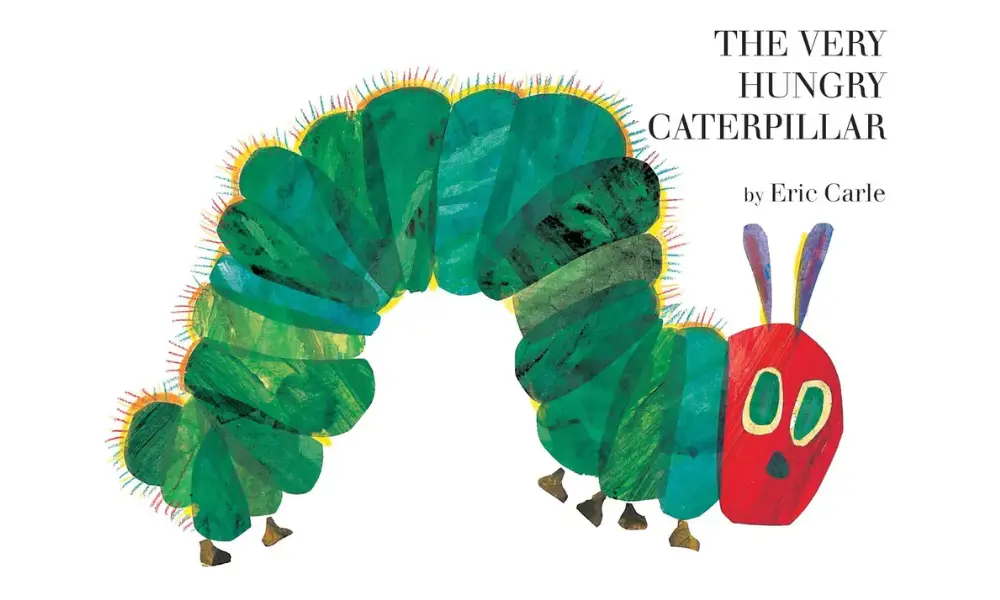
Eric Carle's illustrations are unlike anything else on the picture book shelf. He painted sheets of tissue paper by hand — layering colour, texture, and light — then cut them into shapes and collaged them together. The result is artwork that radiates warmth and movement. Leaves look genuinely leafy. The caterpillar's green segments seem almost three-dimensional. The butterfly at the end blazes with colour.
The die-cut holes punched through each food page are an inspired design choice: children can poke their fingers through them, tracing the caterpillar's path. It bridges the gap between book and toy, turning a reading session into a full sensory experience. Few picture books have ever used the physical form of the book itself so cleverly.
What Children Learn
Beneath its deceptively simple surface, this book is quietly doing an enormous amount of educational work. Children absorb the days of the week naturally, following the caterpillar from Monday through Sunday. Counting skills develop as the fruit quantities increase from one to five. The concept of healthy versus indulgent eating is introduced — not moralistically, but through simple consequence (stomachache on Saturday). And the life cycle of a butterfly is presented with scientific accuracy wrapped in narrative joy.
For preschool and kindergarten classrooms, the book works equally well as a read-aloud, a math prop, a sequencing exercise, or a springboard for craft activities — making it one of the most versatile teaching tools in early childhood education.
What Works Brilliantly
- Timeless collage art that holds up across generations
- Die-cut pages make it tactile and interactive
- Teaches counting, days of the week, and life cycles
- Short enough for toddler attention spans
- Emotionally satisfying arc with a triumphant ending
- Available in board book format for the youngest readers
Things to Be Aware Of
- Very brief — some older children may want more story
- Saturday's food list is quite indulgent (fun, though)
- Die-cut pages can wear with heavy use
Who Is It For?
The Very Hungry Caterpillar is ideally suited for children aged 2 to 5. Toddlers are captivated by the repetitive structure and bright colours. Preschoolers begin to anticipate the counting sequence and delight in naming the foods. Kindergarteners engage with the transformation theme and the life cycle lesson. In a classroom setting, the book remains relevant well into early Key Stage 1.
It also makes a superb gift for newborns — not because a newborn will read it, but because it's a book the family will grow with for years. Parents who were read this as children experience a particular quiet joy reading it to their own.
Legacy & Cultural Impact
First published on 3 June 1969, The Very Hungry Caterpillar has sold well over 50 million copies in 70 languages. It has never once gone out of print. Eric Carle went on to produce dozens of other beloved picture books, but this remains his definitive work — the one immediately conjured when his name is mentioned.
The book has inspired merchandise, theatrical adaptations, classroom curricula, preschool activities, and an entire aesthetic beloved by parents and educators alike. Its distinctive collage style has influenced a generation of children's illustrators. It sits comfortably alongside Where the Wild Things Are and Goodnight Moon in the canon of picture books that define what the form can be at its finest.
Our Verdict
The Very Hungry Caterpillar is one of those rare books that feels inevitable — as if it always existed, and Eric Carle simply found it. Its genius lies in compression: 26 pages that teach counting, sequencing, nutrition, and the life cycle of a butterfly, while also telling a genuinely moving story about growth and transformation. The collage illustrations remain among the most distinctive and beautiful in the entire picture book canon.
If there is one picture book every child should own, this is an exceptionally strong candidate. It earns its reputation entirely.
Frequently Asked Questions
What age group is The Very Hungry Caterpillar for?
The book is recommended for children aged 2 to 5, though its collage art and counting elements make it useful in classroom settings with children up to age 7.
When was The Very Hungry Caterpillar first published?
It was first published on June 3, 1969, by Philomel Books. It has since sold over 50 million copies and been translated into more than 70 languages.
What did the caterpillar eat on Saturday?
On Saturday, the caterpillar ate through ten foods: chocolate cake, ice cream, a pickle, Swiss cheese, salami, a cupcake, a slice of watermelon, a slice of cherry pie, a sausage, and a lollipop — giving him quite the stomachache.
What is the setting of The Very Hungry Caterpillar?
The story is set in an outdoor natural world. It begins on a moonlit leaf, moves through a week of foraging and feasting, and concludes inside a warm cocoon before the final transformation into a butterfly.
What art style does Eric Carle use?
Eric Carle painted tissue paper by hand and then cut and collaged the pieces together. This technique produces the book's distinctive textured, luminous quality — different from any other illustration style in children's publishing.
Is there a board book version?
Yes. A board book edition is available, making it suitable for babies and very young toddlers who benefit from sturdier pages.